


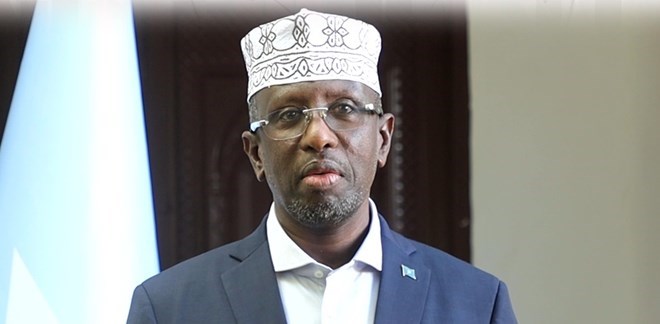
Former Somali President Sharif Sheikh Ahmed has challenged allegations by the National Intelligence and Security Agency (NISA) that his security personnel attacked government forces, instead accusing authorities of restricting access to his residence and targeting members of his office amid escalating political tensions in Mogadishu.
In a statement issued on Sunday, October 11, 2026, Sharif rejected the intelligence agency’s account of the confrontation in Wadajir district, arguing that the accusations did not accurately represent the events surrounding his home in recent days.
The former president’s response came hours after NISA accused armed men it linked to him of attacking its public protection forces in the General Da’ud area of Wadajir, raising fresh questions about the growing standoff between the federal government and prominent opposition figures.
Rather than accepting the agency’s account, Sharif presented a different version of events, alleging that security deployments around his residence had disrupted normal movement, prevented essential supplies from reaching his home and contributed to an increasingly tense atmosphere in the neighbourhood.
Sharif details restrictions around his residence
In his statement, Sharif said the situation around his residence had deteriorated following a series of incidents involving road closures, security deployments and restrictions on movement.
He alleged that the measures had affected people attempting to access the neighbourhood and disrupted the delivery of basic necessities to his home, including food and water.
The former president also claimed that some members of his staff had been abducted, although the statement did not independently establish who was responsible for the alleged abductions or provide details about the individuals involved.
Sharif further expressed concern over the presence of armed personnel near his residence, saying he had sought to avoid an armed confrontation that could endanger civilians living in the surrounding area.
The allegations made by either side had not been independently verified in the available reporting.
What NISA accused Sharif’s guards of doing
In its statement, NISA accused armed men allegedly acting under Sharif’s orders of attempting to provoke a confrontation with its forces in the General Da’ud sector of Wadajir district.
The agency alleged that the men possessed AK-47 rifles, BKM machine guns and rocket-propelled grenades. It also claimed that members of the group had forcibly entered homes in the Tiintiinley neighbourhood.
NISA further referred to earlier incidents, alleging that the same group had attacked its personnel on June 24, 2026, and abducted a soldier who was carrying out official duties. The agency also cited an obstruction of security operations on June 27.
The intelligence agency maintained that its personnel had exercised restraint to prevent the situation from escalating and to protect civilians.
NISA said it would not allow its officers to be drawn into political disputes and insisted that it remained responsible for protecting public security.
However, the agency’s allegations, like the claims made in Sharif’s response, had not been independently verified in the reporting available.
Politicising security institutions
Beyond disputing the accusations against his guards, Sharif used the statement to question the role of national security institutions in politically sensitive situations.
He argued that security agencies should operate independently of political competition and apply the law equally, regardless of an individual’s political position.
The former president also warned against the circulation of claims that could damage the reputations of opposition politicians or influence public perceptions before the circumstances had been established.
“The NISA claim cannot change the truth, nor can it serve as a judgment to justify the blood of opposition politicians,” Sharif said in his statement.
He also urged the intelligence agency to stop what he described as misleading the public, pointing to the humanitarian pressures facing Somalis, including displacement, severe weather and concerns over the loss of property.
Sharif’s remarks reflected his concern that the security dispute could deepen political divisions if allegations were used to justify further pressure on opposition leaders.
He called for incidents involving security personnel to be properly documented and investigated, with those found responsible for wrongdoing held accountable.
Security deployments add to Mogadishu tensions
Sharif’s statement came amid reports of increased security deployments near the residences of opposition figures in the Somali capital.
Reports published on October 11 indicated that government troops and military vehicles had been positioned around the homes of Sharif and former Prime Minister Hassan Ali Khaire, while road closures and movement restrictions affected nearby neighbourhoods.
The reported deployments have added to concerns about the possibility of a confrontation involving government security forces and personnel aligned with opposition leaders.
The dispute also comes against the backdrop of wider disagreements over Somalia’s political direction, constitutional changes and electoral arrangements.
In June 2026, Reuters reported clashes between government forces and militias aligned with opposition politicians in Mogadishu amid tensions over President Hassan Sheikh Mohamud’s decision to remain in office following the expiry of his term. The report noted that claims made by Sharif and other opposition figures about government operations could not be independently verified at the time.
The earlier confrontation illustrates how political disagreements in the capital have previously spilled into security incidents involving armed actors, raising concerns about the consequences for civilians.
Neither side’s public account independently settles those questions.