


Somalia’s controversial 4.5 clan-based power-sharing formula should not become a permanent political arrangement, Islamic scholars have declared, calling for the country to build a system that protects citizens’ rights instead of allowing clan identity to determine how power and resources are distributed.
The scholars said the arrangement currently used to share political representation should not be treated as a lasting framework for governing Somalia, warning that clan affiliations must never become instruments for oppression, exploitation or plundering public resources.
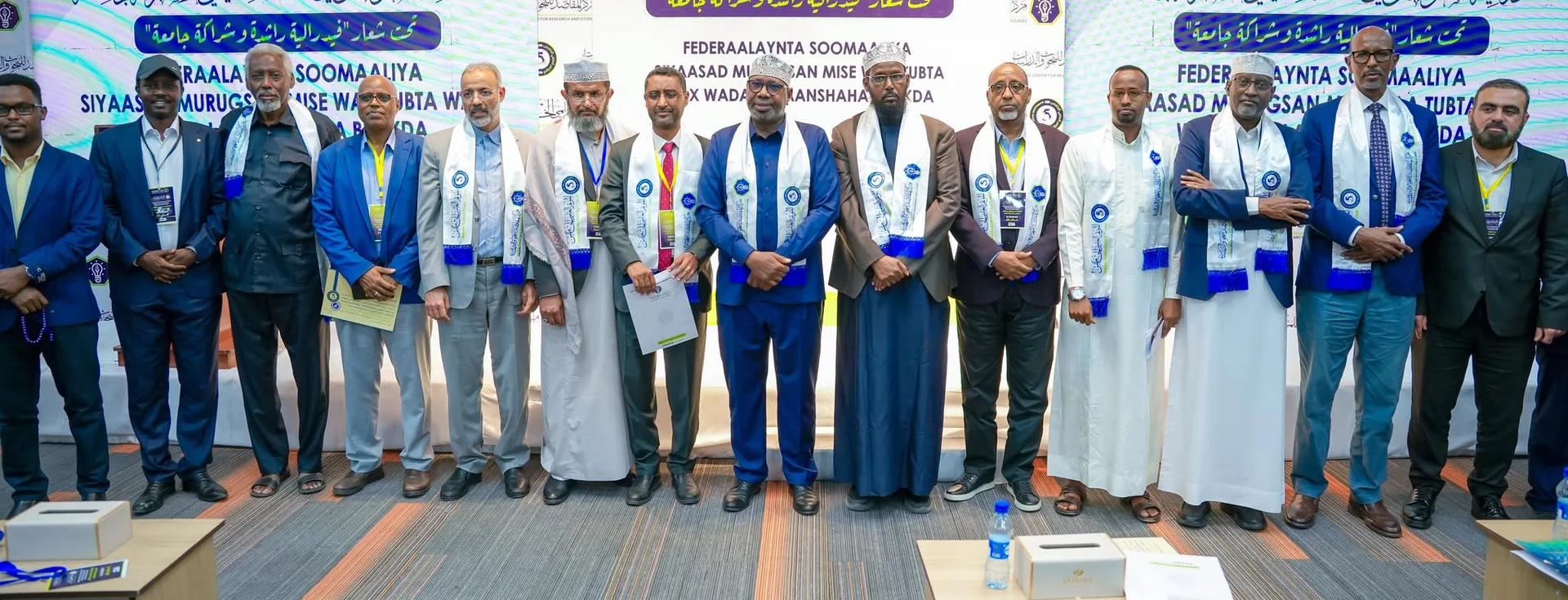
Their position was contained in a closing statement issued on Thursday, November 26, after a two-day conference organised by the Maqasid Center for Research and Studies in Mogadishu.
The sixth annual conference brought together Islamic scholars, researchers, experts and government officials from Somalia and other countries under the theme “Civilisational Integration in the Horn of Africa: A Strategic Vision Based on the Objectives of Islamic Sharia.”
In its statement, the conference acknowledged that clans could play a useful role in mediating disputes and bringing communities together. However, it cautioned against turning clan identity into a tool for controlling political positions, denying people their rights or exploiting public resources.
“The 4.5 system that Somalis currently use must not be taken as a permanent political system for dividing the rights of society,” the statement said.
The 4.5 formula is a clan-based power-sharing arrangement through which Somalia’s major clan groupings receive equal shares of political representation, while a collection of smaller clans receives half the share allocated to each of the four major groupings.
The arrangement has been used in Somalia’s political negotiations and the distribution of parliamentary seats and government positions, particularly during periods when the country struggled to establish a fully functioning national electoral system.
The scholars’ declaration therefore raises questions about whether a formula originally used to manage political representation should continue shaping the country’s governance indefinitely.
Scholars call for stronger institutions and fair distribution of power
Beyond the 4.5 formula, the conference called on Somalia to strengthen institutions responsible for protecting citizens’ rights and holding public officials accountable.
It urged the country to safeguard the independence of the judiciary and oversight bodies, arguing that government officials should face accountability for their decisions and use of public resources.
The scholars also called for a clearer division of responsibilities and revenue between the Federal Government and federal member states.
They said decisions on how power and resources are distributed should involve public consultation and expert input rather than being determined through political arrangements that exclude sections of society.
The statement further argued that consultation should go beyond meetings and agreements between political leaders. It should be supported by strong institutions, an independent judiciary, security, transparent administration and respect for the rule of law.
Somalia urged to address internal challenges before regional integration
The conference also called on countries in the Horn of Africa to address their own political, security and economic problems before pursuing deeper regional cooperation.
For Somalia, the scholars said peace and improved movement of goods and people across the country should come before efforts to integrate more closely with neighbouring states.
They pointed out that travelling between several parts of Somalia remained difficult and called for investment in infrastructure, particularly roads, to connect communities and improve trade.
The statement also urged Somalia to play a greater role in regional organisations such as the Intergovernmental Authority on Development (IGAD).
It identified trade, transport, energy and education as areas where stronger cooperation could benefit countries across the Horn of Africa.
Scholars raise concerns over religious messaging and media
The two-day meeting also addressed the role of religious leaders and media organisations in shaping public attitudes.
The scholars called for reforms in religious discourse and clear rules to prevent media outlets from spreading messages that incite hatred or deepen divisions within society.
They further urged Somalia to ensure that national policies and laws reflect the objectives of Islamic Sharia, including the protection of religion, life, intellect, property and lineage.
The Maqasid Center said it would forward the conference recommendations to government institutions, universities, civil society organisations and media outlets for consideration.