


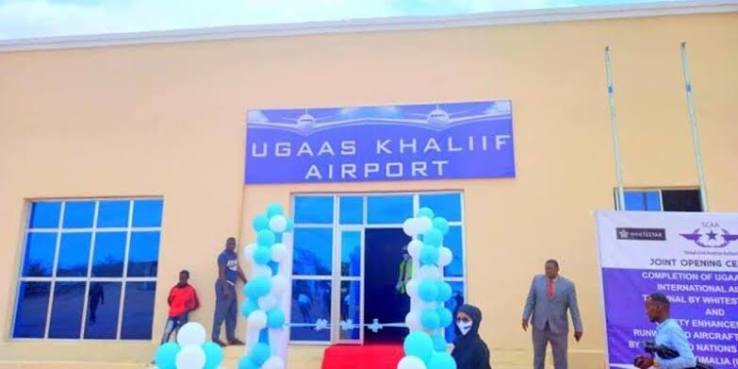
Passengers travelling to and from Beledweyne have been hit by another disruption after Somalia’s aviation authorities ordered the closure of Ugaas Khaliif Airport, just days after flights resumed following a deadly confrontation involving local militia fighters and Djiboutian peacekeepers.
The Somali Civil Aviation Authority (SCAA) suspended all flight operations at the airport until December 1, 2026, in a decision that has once again disrupted air transport in the central Somali city.
The reversal raises fresh concerns about the security of one of Beledweyne’s important transport links, particularly after attempts to restore normal operations failed to resolve tensions involving armed groups around the airport.
Aviation authority grounds all flights
In a Notice to Airmen (NOTAM) issued on Tuesday, November 24, the Somali Civil Aviation Authority announced that Ugaas Khaliif Airport had been closed under reference number A0165/26.
The directive applies to all aircraft operating under Instrument Flight Rules (IFR) and Visual Flight Rules (VFR), meaning that both flights relying on instrument navigation and those operating under visual conditions are affected.
Hirshabelle State’s Ministry of Transport and Aviation provided a clearer explanation in a separate statement, warning that the continued presence of local armed groups around the airport had made it difficult to guarantee the safety of passengers, airport workers and aircraft operations.
The ministry said the decision was intended to prevent passengers and aviation personnel from being exposed to further danger.
What happened during the deadly airport confrontation?
The latest closure follows an armed confrontation on November 19 involving fighters from the local Dulmi Diid militia and Djiboutian peacekeepers serving under the African Union Support and Stabilisation Mission in Somalia (AUSSOM).

The confrontation erupted after local fighters reportedly received information that an aircraft carrying additional federal government soldiers was travelling from Mogadishu to Beledweyne.
The militia members moved towards the airport to prevent the aircraft from landing, triggering an exchange of gunfire with Djiboutian troops stationed at the facility.
At least one militia fighter was killed and six others wounded during the fighting, according to local reports.
The Djiboutian Embassy in Mogadishu subsequently said its troops had repelled an attack on the airport and confirmed that none of its personnel had been killed or injured.
The incident forced the airport to close for four days, disrupting air transport between Beledweyne and other Somali destinations.
Why the airport’s reopening did not last
After the confrontation, Hirshabelle authorities directed AUSSOM troops and Somali security personnel to prevent armed individuals from accessing the airport.
On Sunday, November 22, three federal lawmakers, Abdirisaaq Abdullahi Ma’alin, Abdinasir Haji Shirwac and Mohamed Abdullahi Burale, held discussions with senior AUSSOM Sector Four commanders in an effort to resolve the standoff.
The meeting produced an agreement to reopen the airport on Monday, November 23, withdraw troops stationed outside its premises and prohibit aircraft carrying additional federal military personnel from landing there.
The parties also agreed to hold further discussions concerning the casualties resulting from the confrontation.
However, the reopening did not resolve the underlying security concerns. The continued presence of local armed groups around the facility meant Hirshabelle authorities could still not guarantee safe airport operations.
Consequently, the aviation authority issued the fresh closure notice on Tuesday, barely a day after flights had resumed.
The confrontation has also exposed deeper political disagreements in Hiiraan region, where some traditional elders, politicians and militia groups have challenged the leadership of Hirshabelle State.
The tensions intensified following the October re-election of President Ali Abdullahi Hussein Gudlawe and the election of Abdifatah Hassan Afrah as vice president.