


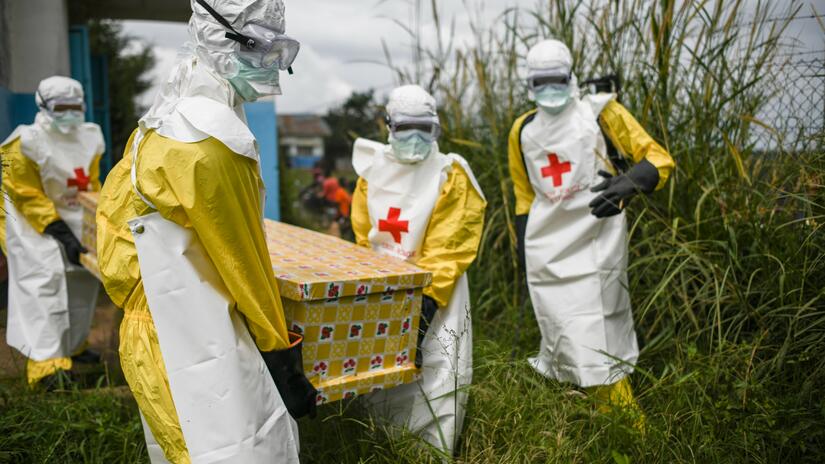
Somalia has stepped up health surveillance at its airports after neighbouring Kenya confirmed its first imported case of Bundibugyo Ebola virus disease, prompting Mogadishu to strengthen measures aimed at preventing the virus from entering the country.
Health teams have been deployed to monitor passengers arriving on flights from African countries, with particular attention being paid to travellers who may have recently been in areas affected by the Ebola outbreak.
Somalia’s Health Minister Dr Ali Haji Adan said the heightened measures were part of efforts to detect any suspected case early and prevent possible transmission within the country.
“We have deployed a medical team to the airport to monitor flights arriving from African countries. We are now intensifying our preparedness after Ebola reached Kenya,” the minister said.
The move came after Kenya confirmed on October 6 that a Kenyan citizen who had been living in the Democratic Republic of Congo had tested positive for Bundibugyo Ebola virus disease and later died in Nairobi.
Kenya’s Ministry of Health said the patient had fallen ill about a month before travelling and had received treatment at several hospitals in the DRC. He subsequently travelled by road to Kampala, Uganda, before boarding a Jambojet flight to Nairobi on October 3.
The journey has since become an important part of Kenya’s investigation because it involved movement across several borders before the infection was confirmed.
After landing at Jomo Kenyatta International Airport, the patient was taken to Nairobi Hospital, where he was isolated and assessed before being transferred to an isolation facility.
Laboratory testing by Kenya’s National Virology Reference Laboratory and the Kenya Medical Research Institute independently confirmed that he had Bundibugyo Ebola virus disease.
Kenyan authorities have identified 28 contacts, including relatives and healthcare workers who attended to the patient, while efforts were also under way to trace 23 passengers and four crew members who travelled on the same flight.
Why Somalia has heightened surveillance
For Somalia, Kenya’s case has added urgency to preparations that were already being maintained because of the wider Ebola situation in the region.
The Somali government’s immediate concern is to identify travellers who could potentially have been exposed to the virus before they move further into the country.
Airport screening is particularly important because air travel can allow an infected person to move between countries before symptoms become obvious.
Somalia has therefore placed medical personnel at airports to monitor incoming passengers and strengthen the country’s ability to identify people who may require further assessment.
The latest measures also reflect the importance of cross-border coordination in responding to infectious diseases in East and Central Africa, where people regularly move between countries for business, employment, trade and family reasons.
Kenya’s experience has demonstrated how an infection acquired in one country can reach another through a traveller moving across multiple borders.
The Congo outbreak behind the regional concern
The Kenyan case was linked to the ongoing Ebola situation in the Democratic Republic of Congo, where authorities have been battling an outbreak of the Bundibugyo strain.
The World Health Organization said following Kenya’s confirmation that it was supporting the country in intensifying case investigation, contact monitoring, screening at high-risk points of entry and public risk communication.
The outbreak has consequently become a regional health concern, with neighbouring countries strengthening surveillance to detect possible imported infections before they result in wider transmission.
Kenya had already maintained heightened Ebola preparedness since the outbreak began in May 2026. By October 6, its authorities said more than 652,000 travellers had been screened and 267 samples tested through laboratories in Nairobi, Kisumu and at the Busia and Lwakhakha border points.
The confirmation of the imported case nevertheless exposed the difficulty of detecting infections when people travel across borders before their illness is identified.
Reuters reported that the Kenyan traveller passed through Uganda before flying to Nairobi, despite multiple layers of screening. Kenyan authorities were subsequently working to establish how he passed through the different points without being identified as a suspected Ebola case.
That experience has added another dimension to Somalia’s decision to reinforce checks on travellers arriving from countries across the continent.