


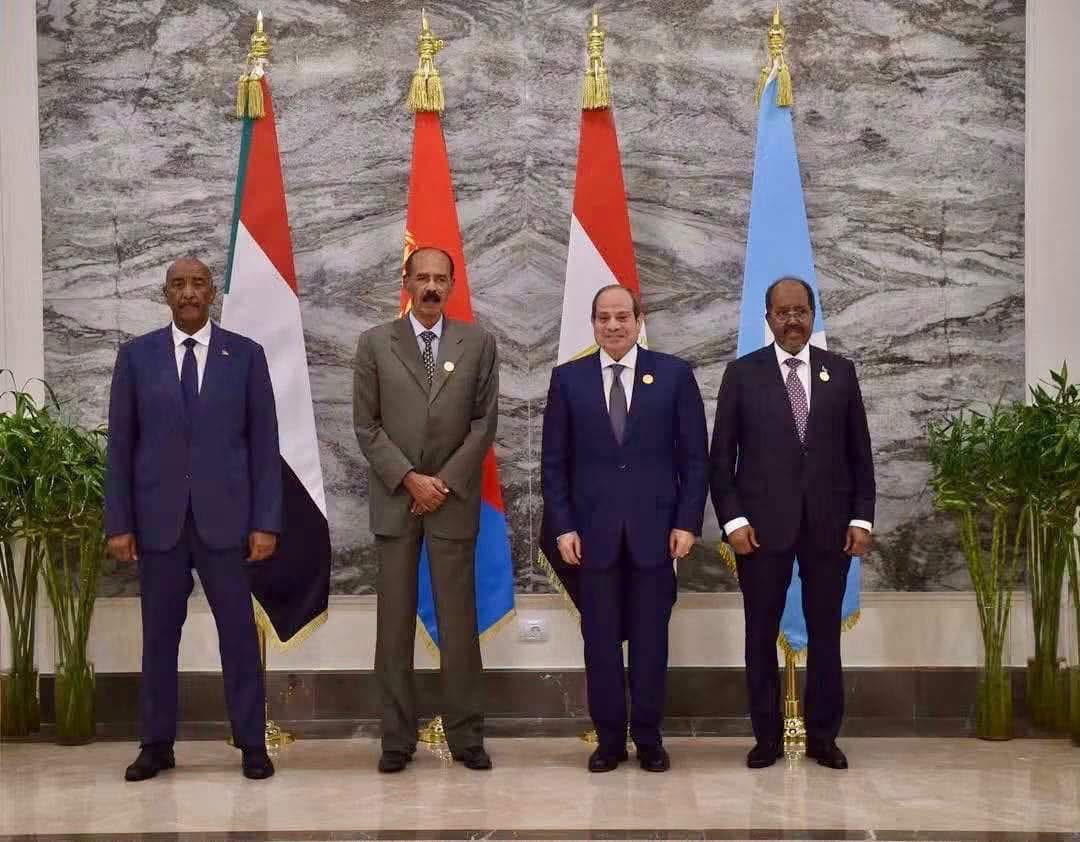
Somalia has secured a fresh regional diplomatic boost after Egypt, Eritrea and Sudan joined Mogadishu in rejecting any recognition of or support for Somaliland, in a joint declaration issued after a high-level summit in Egypt.
The position was adopted on Sunday, October 4, during a quadrilateral consultative summit in New Alamein attended by Somali President Hassan Sheikh Mohamud, Egyptian President Abdel Fattah El-Sisi, Eritrean President Isaias Afwerki and Sudanese leader Abdel Fattah Al-Burhan.
In a significant statement on Somalia’s territorial integrity, the four leaders reaffirmed their support for the unity and sovereignty of Somalia while rejecting actions they said could undermine the country’s national sovereignty.
They went further by specifically opposing the recognition or support of Somaliland, saying such a move would infringe on Somalia’s sovereignty and territorial integrity.
The position was contained in the El Alamein Joint Declaration, which followed discussions on regional and international developments as well as political, trade and economic cooperation among the four countries.
In a statement shared by Somalia’s Foreign Minister Ahmed Moallim Fiqi on October 4, the leaders said their discussions centred on strengthening cooperation while respecting international law and the sovereignty of countries in the region.
“The Summit underscored the necessity of adhering to the fundamental principles and pillars of international law as the foundation for regional stability and cooperation, particularly respect for the sovereignty, independence, and territorial integrity of the states of the region,” the declaration stated.
The document then addressed Somalia specifically, saying the four countries supported its unity and sovereignty and rejected actions directed at its territorial integrity and national sovereignty.
“Supporting the unity and sovereignty of the Federal Republic of Somalia; rejecting any interference or actions targeting its territorial integrity and national sovereignty; and rejecting any recognition of or support for the so-called ‘Somaliland’, as this constitutes an infringement upon the sovereignty and territorial integrity of the Federal Republic of Somalia,” the declaration stated.
The wording is significant because the four countries did not limit their position to opposing formal diplomatic recognition. They also rejected support for Somaliland, potentially widening the scope of their joint position as Somalia seeks to preserve its territorial integrity and prevent further international moves involving Hargeisa.
Somaliland declared independence from Somalia in 1991 and has operated as a self-governing territory for decades, although Mogadishu continues to regard it as part of Somalia.
The issue has become more prominent since Israel recognised Somaliland in December 2025, becoming the first country to formally do so. The development has since intensified diplomatic debate over Somaliland’s status and Somalia’s territorial integrity.
Leaders back Somalia’s security campaign
The four leaders also expressed support for Somalia’s ongoing efforts to combat terrorism and strengthen the authority of its national institutions.
They called on regional and international partners to provide adequate, sustainable and predictable funding for the African Union Support and Stabilization Mission in Somalia (AUSSOM).
The declaration said the funding was necessary to support Somalia’s security transition and enable AUSSOM to carry out its mandate, including the orderly transfer of security responsibilities to Somali forces.
“Supporting the Federal Republic of Somalia’s counter-terrorism efforts and the empowerment of state institutions to extend their control over the entire territory; and calling upon regional and international partners to provide adequate, sustainable, and predictable funding for the African Union Support and Stabilization Mission in Somalia (AUSSOM),” the declaration stated.
The leaders’ backing comes as Somalia continues to seek greater responsibility for its own security operations while relying on international and regional support in the fight against armed groups.
The summit also produced a joint position on the strategically important Red Sea and its surrounding waterways.
The leaders affirmed freedom of navigation while declaring that governance of the Red Sea is the responsibility of countries bordering the waterway.
“Affirming the principle of freedom of navigation and that the governance of the Red Sea is the exclusive responsibility of the littoral states,” the declaration stated.