


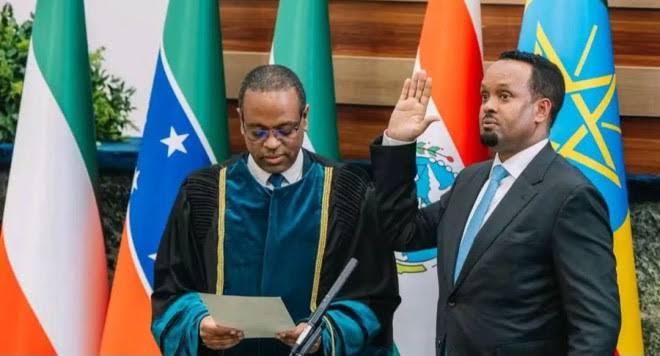
Ahmed Shide has risen to one of Ethiopia’s most powerful political offices after being elected Speaker of the House of Peoples’ Representatives, giving the country’s Somali community a historic breakthrough at the centre of federal politics.
Shide, the former Finance Minister, was elected on Monday as Ethiopia opened the seventh parliamentary term, taking charge of the lower chamber at the beginning of a new five-year political cycle.
His elevation is particularly significant because he becomes the first ethnic Somali to serve as Speaker of the House of Peoples’ Representatives, placing an Ethiopian Somali politician at the helm of the chamber responsible for passing federal legislation and exercising oversight over the executive.
The appointment also represents a major change in Shide’s own political career. After nearly eight years overseeing Ethiopia’s finances, he has moved from the executive arm of government to the leadership of the federal legislature.
He succeeds Tagesse Chafo, who had occupied the Speaker’s position since 2018.
Shide’s rise did not happen in isolation. His appointment formed part of a broader reorganisation of Ethiopia’s federal institutions as the country transitioned into a new parliamentary term following the June 1 general election.
The House of Peoples’ Representatives also elected Ayelech Eshete as Deputy Speaker. Eshete previously served as State Minister of Education and has held several other government positions.

Across the parliamentary divide, the House of Federation selected former senior government official Muferihat Kamil as its new Speaker, while Desta Ledamo was appointed Deputy Speaker.
Muferihat brings considerable experience to the upper chamber, having previously served as Minister of Labour and Skills and Minister of Peace. She had also previously occupied the Speaker’s seat in the House of Peoples’ Representatives.
Desta, meanwhile, comes to the position after serving as president of the Sidama Regional State.
The new leadership arrangements mean both chambers of Ethiopia’s federal Parliament now have fresh presiding officers as the country begins another five-year cycle.
The House of Peoples’ Representatives is the lower chamber of the federal legislature and plays a central role in passing laws, approving the federal budget and scrutinising the work of the executive.
The House of Federation has a different constitutional mandate, with responsibilities that include matters relating to Ethiopia’s federal system and the rights and interests of the country’s nations, nationalities and peoples.
From Somali Region to the heart of federal power
For Shide, the journey to the Speaker’s chair has stretched across both regional and federal politics.
Before becoming one of Ethiopia’s longest-serving economic policymakers, he held leadership positions in the Somali Regional State, including serving as Speaker of the regional parliament and chairing the Somali People’s Democratic Party.
He later moved into the federal government, serving as State Minister in the Ministry of Finance and Economic Development for more than eight years.
His transition into the national executive accelerated in the second half of the 2010s. He served as Minister of Transport between 2016 and 2018 and briefly held the government communication portfolio before taking over the Finance Ministry in October 2018.
His tenure at the Finance Ministry coincided with one of Ethiopia’s most consequential periods of economic restructuring.
He was at the centre of reforms that included efforts to reshape the country’s economy, negotiate external debt and implement a programme supported by the International Monetary Fund.
Ethiopia’s Finance Ministry records that Shide also worked on economic cooperation and regional development and integration during his years as a state minister.
His educational background is similarly rooted in economics and development. He studied economics at the Ethiopian Civil Service College before pursuing postgraduate studies at the Institute of Development Studies at the University of Sussex in the United Kingdom. The Finance Ministry also lists postgraduate qualifications in rural resource and conflict management and an MBA among his academic credentials.
A historic Somali moment
Shide’s appointment carries a particular weight for Ethiopia’s Somali population because it places an ethnic Somali in charge of the lower house of the federal Parliament.
The distinction is important within Ethiopia’s two-chamber parliamentary system.
An ethnic Somali has previously held a senior parliamentary position at the federal level. Aden Farah Ibrahim served as Speaker of the House of Federation, the upper chamber, beginning in 2020.
Shide’s election is therefore historic specifically because he becomes the first ethnic Somali to lead the House of Peoples’ Representatives, the lower and principal legislative chamber.
His new position gives him responsibility for presiding over lawmakers from across Ethiopia’s federal system and places him directly at the centre of the legislative process during Abiy Ahmed’s second term.