


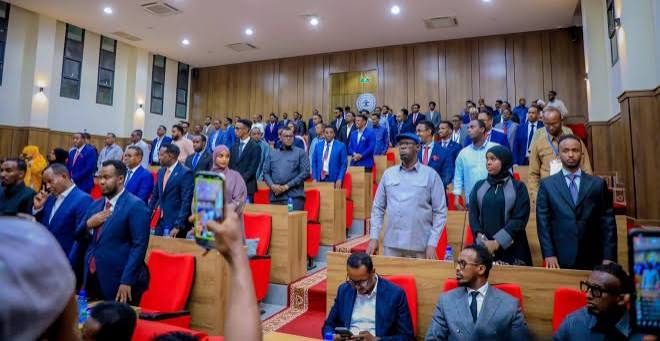
Galmudug’s new government has placed women in just six of its 66 positions, with only one female appointee securing a full ministerial portfolio in a cabinet dominated by men.
Regional leader Liibaan Ahmed Hassan announced the appointments on Sunday evening, naming 24 full ministers, 18 state ministers and 24 deputy ministers to serve in the administration.
The appointments were made through Leader’s Decree LR-007, which outlined the composition of the new government and the individuals selected to oversee different departments in the regional administration.
Of the 24 full ministerial positions, only Haweya Isma’il Ahmed was appointed a woman, taking charge of the Ministry of Family, Children and Human Rights.
The remaining 23 full ministerial positions went to men, leaving women with one seat in the cabinet responsible for overseeing some of the region’s most important government departments.
Women receive six positions across the government
The gender imbalance extends beyond the full ministerial appointments, with women securing only six positions across the three categories of government officials announced by Hassan.
Two women were appointed state ministers, with Salma Mohamed Eid taking the environment, wildlife and climate change portfolio, while Anab Mohamed Osoble was named state minister for family, children and human rights.
Three others were appointed deputy ministers. Asma Abdulaziiz Hassan was assigned to family, children and human rights, Hamdi Ahmed Sa’iid to investment and foreign cooperation, and Hawo Moahmed Iiman to communications and technology.
The appointments mean women account for six of the 66 government positions, representing approximately nine per cent of the new administration.
Men, meanwhile, occupy the remaining 60 positions, including the top jobs in key departments such as finance, internal security, interior, justice and information.
Cabinet size raises questions about representation
The new administration has 66 officials spread across three levels of government, with 24 full ministers, 18 state ministers and 24 deputy ministers.
The size of the cabinet means women have been appointed across several departments, but their representation remains limited compared with the number of positions available.
The decree cited Articles 50 and 55 of the Galmudug constitution as the legal basis for the appointments, which were made following consultations with the regional leader’s deputy.
Hassan said the appointments were intended to bring capable individuals with the knowledge and experience required to serve in their respective positions.
The decree took effect upon signing and was scheduled for publication in the state’s official gazette.
The appointments come against the backdrop of longstanding political commitments in Somalia to increase women’s participation in leadership, including a proposed 30 per cent quota for women in the federal parliament.
However, the target has repeatedly fallen short, with women’s representation remaining limited in federal and regional political institutions.
Galmudug’s latest cabinet appointments reflect the continuing gap between those commitments and the actual distribution of political positions, with women occupying only six of the 66 posts announced on Sunday.