


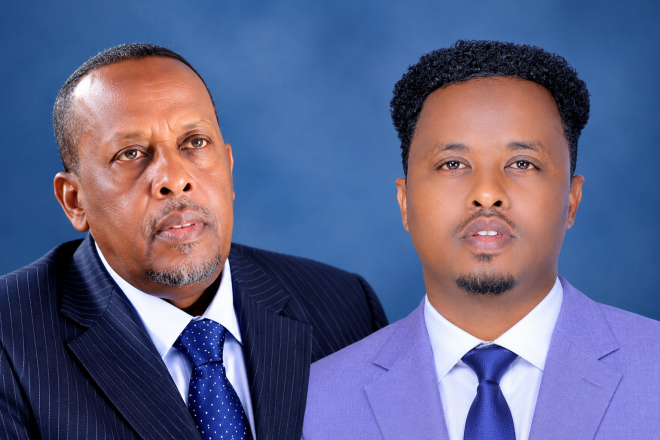
A politician who publicly announced plans to become Somalia’s next president has been sentenced to one year in prison in Somaliland, while the journalist who interviewed him has received a separate three-month jail term.
The Maroodi Jeex Regional Court in Hargeisa delivered the sentences on Monday, November 16, 2026, bringing an unusual case involving Somalia’s 2027 presidential ambitions, a television interview and the sensitive question of Somaliland’s relationship with Mogadishu to a courtroom conclusion.
The politician, Abdikadir Mohamed Sharaay, had been in custody since October 16, when he was arrested following an appearance on Horn Cable TV. During the interview, he openly declared his intention to contest Somalia’s next presidential election.
The journalist who conducted the interview, Abdirahman Mohamed Egeh, was also arrested days later, on October 22, after responding to a summons from Somaliland’s Criminal Investigation Department.
Their detention meant that both men remained in custody for weeks before the regional court announced their respective sentences.
Sharaay received 12 months behind bars, while Egeh was handed three months, bringing their combined prison terms to 15 months.
The court’s decision has drawn attention to the circumstances surrounding the television appearance, particularly because the journalist who questioned the politician about his ambitions was also convicted and sentenced.
Explosive remarks
Sharaay’s appearance on Horn Cable TV went beyond announcing his interest in Somalia’s highest political office. He also discussed how Somaliland should pursue international recognition, touching on an issue that remains particularly sensitive in Hargeisa.
During the interview, he argued that Somaliland should seek recognition through negotiations with Mogadishu rather than depending on Israel and other foreign governments.
His remarks generated debate on social media, with some Somaliland politicians and commentators calling on authorities to take action against him.
The politician was subsequently arrested on October 16, while Egeh, who had hosted the interview, was detained six days later after receiving a summons from the Criminal Investigation Department.
The case placed the television journalist at the centre of a controversy that had initially revolved around a politician’s presidential ambitions and views on Somaliland’s political future.
Politician maintains support for Somaliland’s independence
During court proceedings, Sharaay maintained that he supported Somaliland’s statehood and recognised Somaliland and Somalia as two separate and independent countries.
He also presented evidence indicating that he had previously expressed the same position, apparently seeking to demonstrate that his views on Somaliland’s independence had not changed.
However, the court ultimately sentenced him to one year in prison.
The specific criminal charges used to convict Sharaay and the legal provisions relied upon by the court were not immediately made public. It was also unclear whether he intended to challenge the decision through an appeal.
The same uncertainty surrounded Egeh’s conviction, with no immediate clarification on the precise legal grounds for the three-month sentence.
Press freedom concerns after journalist’s arrest
Egeh’s arrest had already attracted criticism from press freedom organisations, which questioned why a journalist was being held after interviewing a politician about his political ambitions.
On October 28, the Committee to Protect Journalists (CPJ) demanded his immediate and unconditional release, saying he had been detained without charge for nearly a week.
The organisation argued that conducting an interview was part of the journalist’s professional responsibilities and expressed concern over his continued detention.
“Abdirahman Mohamed Ege has committed no crime, and the fact that he has been arrested for doing his job is a worrying sign that Somaliland authorities do not respect press freedom,” said Muthoki Mumo, CPJ’s Africa programme coordinator.
CPJ further reported that Egeh had been questioned about his interview with Sharaay and that Somaliland authorities had not responded to its requests for comment.
The court’s latest decision means that the journalist has now received a three-month prison sentence, despite the international organisation’s earlier appeal for his unconditional release.
The case touches on two politically sensitive issues in Somaliland: its claim to independence from Somalia and the coverage of political developments in Mogadishu by local media.
Somaliland declared independence from Somalia in 1991 and has since operated its own government, security forces and institutions. However, Somalia’s Federal Government continues to regard the territory as part of the country.