


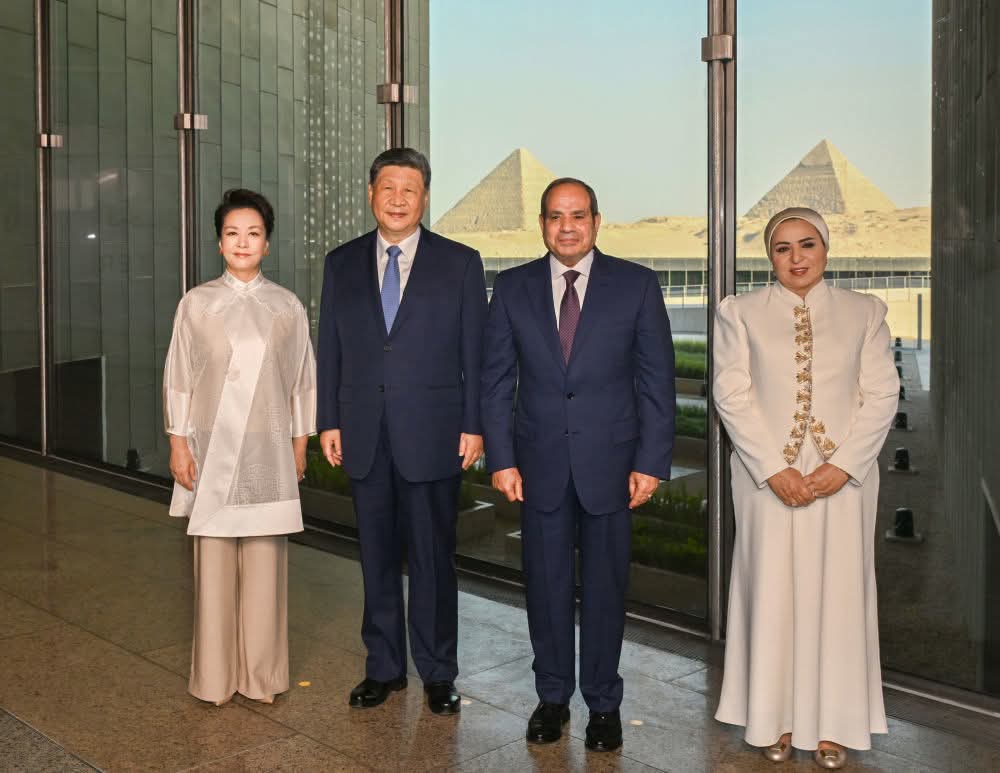
CAIRO — Chinese President Xi Jinping’s arrival in Cairo marks his first visit to Egypt in a decade, placing the rapidly expanding China-Egypt relationship at the center of regional attention. The visit comes as Beijing and Cairo deepen cooperation across defence, security, trade, infrastructure and strategic investment, giving their partnership growing significance in the Middle East and Africa.
Military cooperation has emerged as an increasingly important component of the relationship. In August, Egypt hosted its second joint military exercise with China, featuring Chinese J-16 fighter jets alongside French-made Rafale aircraft. The exercise marked the first deployment of China’s J-16s to Africa and demonstrated the expanding scope and sophistication of defence cooperation between Beijing and Cairo.
The development is significant for Egypt as it seeks to diversify its military and strategic partnerships. While the United States remains a longstanding security partner and a major provider of military assistance, Cairo has increasingly sought to broaden its defence relationships with other global powers, including China, Russia and European partners.
For Beijing, closer defence cooperation with Egypt provides an opportunity to strengthen military-to-military relations with one of the Arab world’s most influential states while expanding China’s strategic engagement across Africa and the Middle East.
Xi’s visit also coincides with the 70th anniversary of diplomatic relations between China and Egypt. The two countries established diplomatic ties in 1956, with Egypt becoming the first Arab and African country to recognize the People’s Republic of China. Relations were elevated to a Comprehensive Strategic Partnership in 2014, reflecting the steadily expanding scope of bilateral cooperation.
Trade and Investment at the Core
Despite the growing attention surrounding defence ties, economic cooperation remains the foundation of the relationship. Bilateral trade approached $21 billion in 2025, while Chinese investments exceeding $10 billion have been directed toward manufacturing, infrastructure, logistics and other strategic sectors.
The Suez Canal Economic Zone has become a particularly important area of Chinese engagement. Egypt’s strategic position along one of the world’s most important maritime trade routes makes it an attractive destination for Chinese companies seeking access to African, Middle Eastern and European markets.
For China, Egypt represents more than an investment destination. Its control of the Suez Canal gives Cairo strategic importance to global shipping and supply chains, while its geographic position connects three major regions: Africa, the Middle East and Europe.
China’s growing presence also fits into its broader strategy of expanding economic and diplomatic influence through infrastructure, trade and strategic partnerships. Egypt’s role in the Belt and Road Initiative further reinforces the country’s importance within Beijing’s global connectivity agenda.
Egypt’s Strategic Balancing Act
For Cairo, strengthening ties with Beijing offers access to investment, technology, infrastructure and an additional source of defence cooperation without necessarily abandoning its longstanding relationship with Washington.
Egypt’s approach reflects a broader strategy of strategic diversification. Rather than relying exclusively on one major external partner, Cairo has increasingly sought relationships with multiple global powers to expand its economic options and strengthen its diplomatic leverage.
This balancing strategy, however, also creates challenges. Deeper Chinese military and strategic engagement could attract greater scrutiny from the United States, particularly in areas involving advanced military technology, intelligence cooperation and strategic infrastructure.
A Partnership With Wider Regional Implications
The China-Egypt relationship is therefore evolving beyond conventional bilateral cooperation. Defence exercises, major infrastructure projects, trade, investment and maritime interests are increasingly interconnected, giving the partnership a broader geopolitical dimension.
Egypt’s growing engagement with China could also influence the strategic environment across North Africa, the Red Sea and the wider Middle East, particularly as global powers compete for economic access, military partnerships and influence along major maritime routes.
For Beijing, Egypt provides a strategically located partner with significant political and economic weight. For Cairo, China offers an alternative source of investment, technology and strategic cooperation at a time when Egypt is attempting to strengthen its position amid shifting global alliances.
Xi’s visit ultimately highlights a relationship that has moved well beyond diplomatic symbolism. China and Egypt are building a multidimensional partnership spanning defence, trade, infrastructure, investment and regional strategy—one that could increasingly shape the balance of influence across Africa and the Middle East.